

Why Good Wi-Fi Is About More Than Internet Speed
When Wi-Fi isn't performing properly, one of the first things many businesses do is run a speed test.
If the result looks good, the assumption is that everything should be working properly.
Unfortunately, Wi-Fi isn't quite that simple.
You can have a fast internet connection coming into your building and still experience slow devices, connection drops, dead spots, buffering and poor performance as you move around the premises.
At Sabrecast Solutions, we look at the whole network to understand what's actually causing the problem.
Internet Speed vs Wi-Fi Performance
Your broadband or leased line determines how much connectivity is available to your business.
Your Wi-Fi network determines how effectively that connectivity reaches your wireless devices.
Think of your internet connection as the road into your business and your Wi-Fi network as the roads around it.
Increasing the size of the road coming into the site won't necessarily solve congestion, poor routes or bottlenecks inside it.
The same principle applies to your network.
Upgrading from a 500Mbps connection to a 1Gbps connection won't fix an incorrectly configured access point or a Wi-Fi dead spot.

Access Point Placement Matters
One of the most common Wi-Fi problems we encounter is poor access point placement.
Wi-Fi signals don't simply stop because a specification says an access point can cover a certain distance.
Walls, floors, metal structures, shelving, machinery and even the layout of a building can affect how radio signals travel.
An access point installed in a convenient location isn't necessarily installed in the right location.
This is particularly important in environments such as offices, warehouses, hospitality venues, retail premises and multi-floor buildings.
Sometimes improving coverage can be as simple as repositioning equipment or adjusting how existing access points are configured.

More Access Points Doesn't Always Mean Better Wi-Fi
It can be tempting to solve poor coverage by adding more access points.
But more isn't always better.
Access points need to work together.
Too many access points, poor channel planning or excessive transmit power can actually introduce additional interference and create a worse wireless environment.
In wireless networking, a stronger signal doesn't automatically mean a better network. Good Wi-Fi design is about balancing coverage, capacity, interference and client behaviour.
A well-designed Wi-Fi network is about providing the right amount of coverage and capacity in the right places.
The 2.4GHz, 5GHz and 6GHz Question
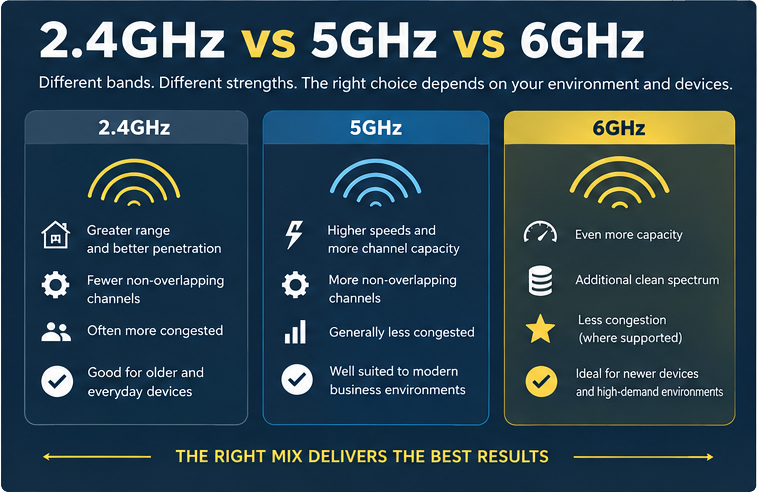
Modern wireless networks can operate across different frequency bands, and each has different characteristics.
2.4GHz generally provides greater range and penetration through obstacles, but there are fewer non-overlapping channels available and the spectrum can be heavily congested.
5GHz provides significantly more channel capacity and is often better suited to modern business Wi-Fi deployments, although coverage characteristics differ from 2.4GHz.
Newer Wi-Fi technologies can also make use of the 6GHz spectrum where supported, providing additional clean spectrum and capacity for compatible devices.
Choosing the right frequency, channel width and transmit power is therefore just as important as choosing the access point itself.
The important point isn't simply to enable everything.
It's to configure the network appropriately for the environment and the devices using it.
Channel Utilisation and Interference
Your Wi-Fi network doesn't operate in isolation.
Neighbouring wireless networks and other sources of radio interference can compete for the same spectrum.
In a busy office building, retail environment or town centre, there could be dozens of nearby wireless networks.
If several access points are trying to communicate on the same or overlapping channels, performance can suffer even when the Wi-Fi signal appears strong.
This is why looking at signal strength alone doesn't tell the whole story.
Channel utilisation, interference, noise and the number of devices competing for airtime all matter.
Roaming Can Be Just as Important as Coverage
Business users don't always sit in one place.
Staff may move between offices, warehouse areas, meeting rooms or floors while remaining connected to Wi-Fi.
A properly designed managed Wi-Fi network should allow devices to move between access points without users constantly having to disconnect and reconnect.
If access points aren't configured correctly, devices can sometimes remain connected to an access point that is further away even though a better one is available nearby.
The result can be a frustrating experience where the Wi-Fi appears connected but performs poorly.
Don't Replace Everything Until You Know What's Wrong
When businesses experience network problems, replacing the hardware can seem like the obvious answer.
Sometimes new hardware is required.
But it shouldn't automatically be the first answer.
Our approach at Sabrecast Solutions is to understand the problem first.
We listen to the issues you're experiencing, review the existing network and Wi-Fi deployment, examine the configuration and identify potential bottlenecks or problem areas.
Where possible, we'll look at changes and improvements that can be made to the existing environment.
That could include:
Adjusting access point settings and transmit power
Reviewing channel configuration
Repositioning access points
Identifying coverage gaps
Reviewing network switching and connectivity
Checking for capacity or utilisation issues
Improving network segmentation
Reviewing how devices move between access points
Only when we've exhausted the sensible options within the existing environment would we recommend replacing hardware.
Where Managed Networking Comes In
For many businesses, getting the network working properly is only half of the job.
It also needs to keep working.
A managed networking service allows the network environment to be monitored, maintained and adjusted as the needs of the business change.
New devices appear.
Staff numbers change.
Businesses expand.
Applications become more demanding.
The network that worked perfectly when it was originally installed may not necessarily be configured appropriately several years later.
That's why good networking isn't simply about installing equipment and walking away.
It's about understanding the environment, maintaining it and making sure the technology continues to support the business.
Experiencing Slow or Unreliable Wi-Fi?
Before increasing your broadband speed or replacing every access point, it might be worth finding out what's actually causing the problem.
At Sabrecast Solutions, we provide networking, managed Wi-Fi and connectivity solutions for businesses across the UK.
From small configuration changes through to complete network redesigns and refits, we'll look at what you already have, understand what your business needs and recommend a solution that makes sense.
Having Wi-Fi problems in your business? Talk to Sabrecast Solutions and let's find out what's really causing them.

